How Balatro helped me better understand my taste in games.
Perhaps the biggest lie I ever told myself is that the story is the primary reason I play video games.
All of my favourite games, and their most memorable, resonant gaming moments? They’re practically all story-related. These are the moments where the act of playing the game meshes seamlessly with how the narrative is being told. The end result is unique to the medium of games, providing an experience that resonates strongly and lingers long after the controller is put down.
Playing a climactic story moment is a wonderful feeling. But these don’t compare to moments where otherwise arbitrary game concepts like saves or options menus suddenly become part of the narrative. My favorite games almost always have a good story and strong characters, or striking audio and visual presentation in addition to consistently enjoyable gameplay.

I’ll point to these things first when discussing what quantifies a good game, or the best use of the medium as an artform. But, again, this is not why I play games.
The true reason I play video games is much simpler: I just fucking love numbers.
Progression vs. Execution
All games can be loosely piled into two categories: those that reward through progression, and those that reward through execution. It could also be likened to extrinsic vs. intrinsic motivation, where extrinsic motivation comes from receiving praise and rewards for what you do in the game, intrinsic motivation comes simply from playing the game for the fun of it. Progression vs. execution.
For better or worse, I am thoroughly extrinsically motivated when it comes to games. Perhaps I’ll find moment-to-moment enjoyment by playing the game, but I usually require a goal I must work towards. Maybe it’s a list of quests I am checking off or working through, or certain achievements or unlocks. When I don’t have those, my interest can quickly wane because the dopamine drip feed has dried up. If I am not progressing, then I am unsatisfied.

There’s no better example than my relationship with fighting games. I love fighting games; whether it be watching, discussing, or playing them, but I never stick with it, and it frustrates me to no end trying to change. It should be an easy fix, right? If I like a game, I should want to play it, so all I have to do is boot them up and yet… I don’t. Or, when I do, I don’t stick with them very long before putting them down again.
In fighting games, the metric is not progression-based, but execution-based. The joy comes from learning how to play better. You practice, you learn, you grow, and you become better. Maybe your win rate will increase, or your ranking and ladder position will go up, but that’s the extent of extrinsic motivation there. And going on a losing spree might actually knock you down, undermining that reward.
So what games do I get drawn to? Often, RPGs or strategy games. Progression in those genres is a much more straightforward affair, delivered extrinsically through the game’s design. RPGs have you fighting opponents — your numbers against theirs — and reward you with incremental progression for each battle you win, tracked through more numbers. Hit thresholds and the numbers go up. That reward is translated mechanically into more numerical power, feeding that dopamine loop.
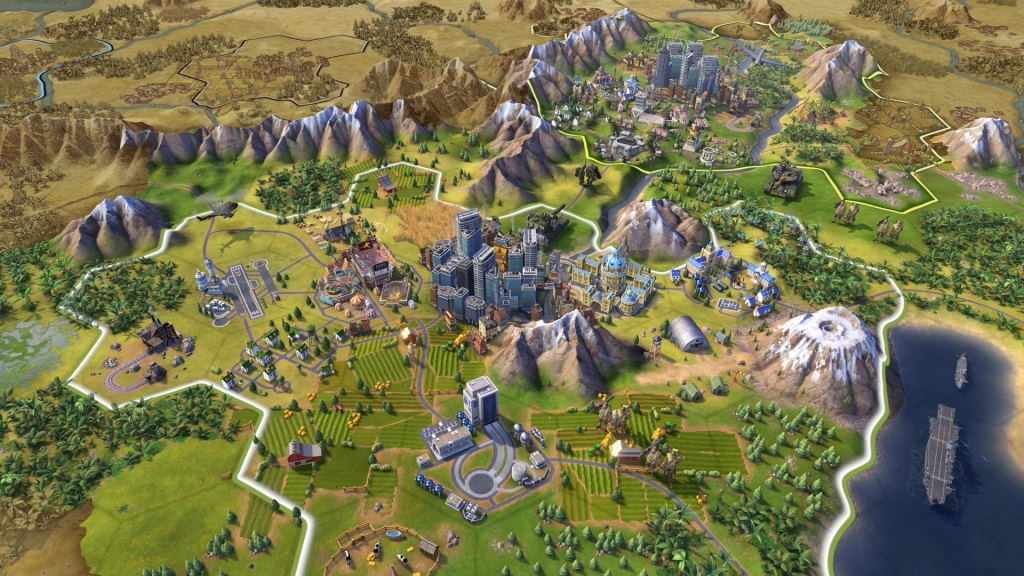
Larger strategy games like Civilization or Stellaris are frequently broken down into different phases, with a number of smaller goals to juggle and achieve. There is an overarching strategy to it — and sometimes even a role-playing aspect — but the core is still allocating my numbers to maximize gains and minimize losses. The number goes up. And in a cage match between execution and the numbers going up, the numbers going up always wins.
By following my enjoyment of numbers, I stumbled onto enough great stories to end up getting hooked, and I’ve been combining the two loves ever since. Even knowing games with strong narratives stand out to me, I still find it difficult to latch onto them without a progression loop.
This reliance on ‘“extrinsic reward gameplay loop” can end up backfiring. I sometimes find myself playing a game, caught up in its loop, but mentally screaming, “I hate this!” These are the exact addiction loops that make predatory gacha games so successful. Addictive behaviors might not claim my money, but they will claim my time.
Enter: Balatro
Poker is already one of the most quintessential “numbers games” out there. Players try to make the best hand while weighing their chances against the hands of the other players. Balatro takes this easily-understood system and uses it as a framework to make a single-player “rogue-like”.
I have played Balatro for well over 200 hours. The only reason I stopped playing it regularly is because I reached the end of its progression loop. I have practically everything unlocked, and only a handful of actions left before I’ve fully completed it. Prior to reaching that near-completion point, Balatro consumed me. I’ve spent entire days mulling away at it, trying to get the best possible hands or trying different combinations to succeed at the hardest challenges it offers. When I wasn’t playing it, I was thinking about it or discussing it with a friend.
Balatro is a numbers game in the purest sense. Every “hand” you play is judged on two numbers: Chips and Mult. Chips are the raw score, which is then multiplied by Mult and totaled. If your cumulative score beats the target goal, you win the round and move on. If not, you’re given a few more hands to try and reach it. Failure to do so means the run is over.

Let’s say you get a Pair of 10s. The base score of a Pair is “10 Chips and 2 Mult.” You add the two 10s to the Chips, making the equation “30 Chips x 2 Mult” for a total of 60 points. Any variation of a hand has a base score calculated in this manner, encouraging you to aim for better hands to beat the required score. Having Two Pairs in the hand nets a base score of “20 Chips and 2 Mult”; Three-of-a-Kind rewards “30 Chips and 3 Mult”; and so on and so forth, all the way up to hands that aren’t possible in a standard game of poker.
So it’s clearly a “numbers game,” but Balatro is also a rogue-lite, which means there are a ton of modifiers you can use to change the outcome. You can increase the base score of each hand type with Planet cards, or mark individual cards within your deck to have bonus scores and effects with Tarot cards. You also acquire Joker cards, which all have their own unique functions; the base Joker that you first start the game with simply adds +4 Mult to every hand you play, so the above example of a Pair of 10s becomes 180 points instead (30 Chips x 6 Mult).
Each completed round rewards you with cash and a chance to visit a shop where you can purchase the aforementioned cards. You get more cash by (typically) using fewer hands to complete a round, and by accruing interest on what you don’t spend. Every action is a small “numbers game” as you figure out which additions are worth purchasing and how much coin is worth holding for later. I’ll frequently sit there weighing options in the shop, figuring out which will lead to higher point hands or more consistent victories. To a lover of numbers, it’s heaven.

But it’s more than just the numbers; Balatro also has extrinsic motivation in spades. Many of the different modifiers and Jokers aren’t available right away; they must be unlocked by accomplishing specific goals within the game. This meta-progression fuels each run, encouraging me to try different strategies or pivot my approach to unlock more things. And when I do, you can be sure the dopamine hits.
Balatro is purely gameplay. It has immaculate presentation in its own low-fidelity way, and you’d better believe the music will burrow into your ears. But at the end of the day, it’s all about the numbers. Everything you do serves to make your numbers larger; there’s still an element of randomness to your card draws, after all. Even if you don’t win the run, you might still end up progressing further, unlocking new ways to change things up in subsequent attempts. It’s addictive without feeling vindictive, bereft of any manipulation or exploitation that can come from additional monetization, which Balatro doesn’t have.
I played Balatro until there was little new left to play, and then I continued playing anyway. I mulled over its design and tried to figure out exactly why such a simple concept appealed to me so aggressively. I wanted to understand Balatro and the effect it had on me. So here we are. In trying to understand Balatro enough to write about it, I learned more about myself.

The Numbers, What Do They Mean?
I came to question what instincts drive my behaviours, and how they draw me to specific games. That long-held consideration of the difference between progression vs. execution as rewards in games proved almost prophetic in understanding just what made me tick.
Through Balatro, I better understand the link to my fixations with the numbers game. Doing so has helped answer questions about why I gravitate towards certain games, and why some games that I should love just don’t click. By understanding why I’ve felt these proclivities, I’ve also found ways in which to channel them in more constructive ways, or learned how to circumvent the impulses and make them work for me. I can better identify the traps that manipulative game design might draw me into, but can also apply those same principles to myself, to the point of even gamifying activities to satisfy that addiction to numbers. Strength lies in knowing oneself, and Balatro has helped me know myself better.
In short, Balatro changed my life, and that’s about as ringing an endorsement as any piece of creative media can hope to receive.

[…] We’ve published several reviews, with more on the way. We’ve run features on Balatro, Warhammer 40,000: Space Marine 2, Like a Dragon, and the importance of playing new […]